Best Guest Post Agency in 2026
Discover the best guest post agencies in 2026. Compare pricing, outreach quality, authority backlinks, niche edits, and white hat SEO services.

Muhammad Abubakr
May 28, 2026 · 14 min read
Introduction
If you've been trying to rank your website and nothing seems to stick, there's a good chance your backlink profile is holding you back.
Guest posting is still one of the most reliable ways to build authority, earn contextual backlinks, and improve organic rankings. But in 2026, the way it works has changed significantly. Google's algorithms are smarter. AI-driven search is reshaping how content gets discovered. And the old "post anywhere, get a link" approach that worked five years ago? It's more likely to hurt you now than help.
What actually works today is precise, editorial-quality outreach on sites that are genuinely relevant to your niche.
That's why choosing the right guest post agency matters more than ever. The wrong one can waste your budget, build a toxic link profile, or worse, earn you a manual penalty. The right one can quietly move your rankings in a meaningful, lasting way.
In this guide, we break down what separates good guest posting agencies from mediocre ones, what to look for in 2026, and why Rank Bloom Outreach has become a trusted partner for SEO agencies, SaaS founders, and growing businesses that take link building seriously.
What Is a Guest Post Agency?
A guest post agency handles the entire process of placing editorial content on third-party websites, with a backlink pointing back to your site. Instead of you spending hours finding relevant blogs, building relationships with site owners, writing content, and managing placements, the agency does all of that for you.
At its best, it's a scalable, hands-off approach to earning high-quality, contextual backlinks that strengthen your domain's authority and improve your visibility in search.
At its worst, it's a link farm dressed up as a service.
The difference between those two outcomes depends almost entirely on the agency you work with.
Why Guest Posting Still Works in 2026
Every year someone declares guest posting dead. Every year the sites that invest in it rank better than those that don't.
Here's what's actually happening.
Google still treats backlinks as one of the strongest signals for ranking pages. That hasn't changed. What's changed is which backlinks Google values. Low-quality placements on irrelevant or spammy sites do almost nothing. But a well-placed link on a real, topically relevant site with genuine traffic? That still moves the needle.
In 2026, there are a few extra layers worth understanding.
Topical authority matters more than raw DR. A backlink from a DR 40 site in your exact niche often outperforms one from a DR 80 site that covers everything from recipes to finance. Google is increasingly focused on entity relevance, not just domain strength.
EEAT signals are now critical. Google's emphasis on Experience, Expertise, Authoritativeness, and Trustworthiness means that where your brand gets mentioned, and in what context, actually matters. Guest posts on credible, well-maintained sites contribute to your brand's perceived authority in a way that private blog networks simply don't.
AI search is changing discovery. With AI Overviews now surfacing in Google and tools like ChatGPT increasingly used for research, getting your brand cited in authoritative content across the web has become a new form of visibility. Guest posting, done right, puts your name in the right places.
The fundamentals of link building haven't changed. The standards have just gotten higher.
What Makes a Great Guest Post Agency
Not all agencies are equal, and the gap between the good ones and the rest is wide. Here's what you should be looking at.
Manual Outreach vs. Automated Spam
There are agencies that use real human outreach, building genuine relationships with bloggers and editors. And there are agencies that blast thousands of templated emails to anyone with a contact form.
The results are completely different.
Manual outreach produces placements on real sites with real audiences. Automated spam produces placements on link farms that exist only to sell links, often flagged by Google as part of link schemes.
Always ask how an agency builds its placements. If they can't clearly explain their outreach process, that's a red flag.
Editorial Standards
The best agencies don't just get your link placed. They make sure the content around it is actually good. That means original writing, real editorial review, and content that serves the reader rather than just stuffing in a keyword and a link.
Google's quality raters can tell the difference. So can site editors, which is why agencies with high editorial standards tend to get placements on better sites.
Niche Relevance Over Vanity Metrics
A lot of agencies lead with domain authority or DR scores. These numbers matter, but they're not the whole story.
A technology blog with DR 55 that publishes thoughtful content about SaaS and startup growth is worth far more to a SaaS company than a lifestyle blog with DR 70 that occasionally publishes tech-adjacent articles.
Topical relevance is the metric that agencies rarely talk about but experts consistently prioritize.
Transparency
Good agencies show you exactly where your links are going before the content goes live. You can review the sites, check the content, and confirm the anchor text. If an agency is vague about placements or only shares results after the fact, you have limited control over your link profile.
Real Traffic on Placement Sites
Domain rating is an estimate. Real traffic is a fact. Sites with actual organic visitors tend to be maintained, editorially active, and indexed regularly by Google. Those are the placements that carry weight. Ask agencies whether they filter by traffic, not just DR.
How Guest Posting Changed in 2026
The core practice is the same. The execution has evolved.
A few years ago, you could get away with thin content, loosely relevant sites, and exact-match anchor text across most of your link profile. Google has since tightened its algorithms significantly.
Here's what's different now:
Content quality thresholds are higher. Google's Helpful Content updates have deprioritized sites that publish content primarily for SEO rather than users. This means that sites willing to publish low-quality sponsored content are often the ones you don't want links from.
Anchor text diversity is non-negotiable. Aggressive exact-match anchor text across a large number of guest posts is a fast track to algorithmic filters. Natural anchor text profiles, with a mix of branded, generic, and partial-match anchors, perform better and stay stable over time.
Site quality is scrutinized more closely. Placement sites that have thin content, no real readership, and obvious monetization through link sales are increasingly devalued. Experienced agencies maintain curated site lists and refresh them regularly.
Entity-based SEO is now a strategic factor. Google understands entities, the real-world people, businesses, and concepts behind search queries. Being mentioned and linked to from topically relevant content helps establish your brand as a recognized entity in your niche.
Red Flags to Avoid When Choosing an Agency
This is worth spending time on, because a bad link building campaign can take months to undo.
Guaranteed placements on hundreds of sites. If an agency promises you 100 guest posts in a month for a suspiciously low fee, those placements are almost certainly on private blog networks or link farms. Quantity at that speed isn't possible through legitimate outreach.
No site list or pre-approval. If you can't review the sites before your content goes live, you have no control over your link profile.
Exact-match anchor text on every link. This is either laziness or ignorance, and neither is acceptable from an agency that's charging for expert services.
No editorial process. If the agency sends you links to articles that look like they were written in five minutes with no subject-matter depth, that content is going on bad sites.
Unusually cheap pricing. Real outreach is labor-intensive. Agencies that charge $20 per guest post are not doing manual outreach. They're running bulk placement through link directories or PBNs.
Guest Posting vs. Niche Edits: What's the Difference?
Both are legitimate white hat link building strategies, but they work differently.
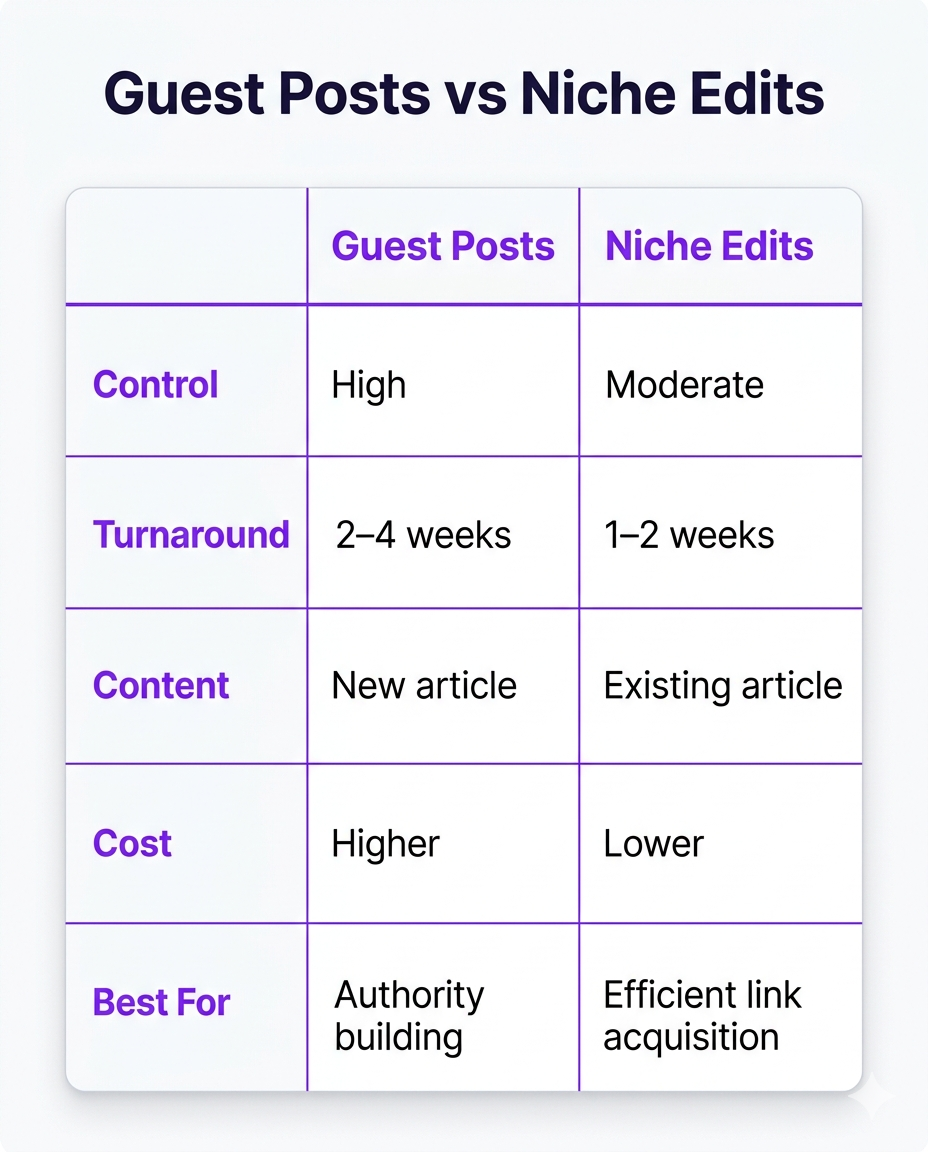
Guest posts involve creating new content and placing it on a third-party site. You control the article, the anchor text, and the surrounding context. It's a longer process but gives you full editorial control.
Niche edits (also called link insertions) involve adding your link into an existing article on a relevant site. The article is already indexed and has its own authority. The turnaround is typically faster and the cost can be lower.
Which one is better? It depends on your goals.
For newer sites trying to build topical authority, guest posts that establish your brand's voice and expertise tend to work better. For more established sites looking to add relevant links efficiently, niche edits are a strong option.
Most serious link building campaigns use both.
Guest Posts vs Niche Edits
How Much Does Guest Posting Cost in 2026?
Pricing varies significantly based on the quality of the placement.
For context, here's a rough breakdown of what different price points typically reflect:
$50–$150 per placement: Usually network-based or semi-automated. Sites are often low-traffic with thin content. Use with caution.
$150–$350 per placement: Mid-range. You'll find a mix here. Some agencies at this level do legitimate outreach; others are still using curated networks. Ask detailed questions.
$350–$700+ per placement: Manual outreach agencies placing content on real editorial sites with genuine traffic. This is the range where you're getting links that actually contribute to rankings.
$700+: High-authority placements on major publications, industry leaders, or sites with significant organic traffic. Worthwhile for competitive niches or targeted domain authority campaigns.
Budget matters. But treating guest posting purely as a cost-cutting exercise tends to produce links that either do nothing or cause harm. The ROI on a well-placed $400 link on a real, relevant site far exceeds that of ten $30 links on questionable ones.
Best Guest Post Agency in 2026: Why Rank Bloom Outreach Stands Out
Rank Bloom Outreach was built around one idea: that link building only produces results when it's done with genuine care about quality and relevance.
That might sound obvious, but in practice, it's rare.
Here's what that looks like in execution:
Every outreach campaign is manual. The team builds real relationships with site owners and editors. No bulk email tools. No link exchanges. No private networks.
Site selection is based on relevance, not just metrics. Before any site gets added to a campaign, it's evaluated for niche fit, content quality, real organic traffic, and editorial standards. DR is one factor among many, not the only one.
Content is written to actually be useful. The articles placed through Rank Bloom Outreach are written to serve the readers of the placement site, not just to carry a link. That means better editorial acceptance rates and placements that hold long-term value.
Full transparency before content goes live. Clients see the sites before placement. You can review, approve, or request alternatives. Your link profile stays in your control.
Flexible for different business types. Whether you're a SaaS company trying to build topical authority in a competitive space, an affiliate marketer who needs consistent niche placements, or an agency managing link building for multiple clients, the campaigns are structured to fit the actual objective.
Rank Bloom Outreach also offers niche edit services for faster, cost-effective link acquisition on relevant existing content. For SaaS businesses in particular, where competition is high and audience specificity matters, this combination of guest posts and niche edits is often the most efficient path to ranking improvement.
Guest Posting for SaaS Companies
SaaS is one of the most competitive niches for SEO. Keywords are contested, CPCs are high, and Google is full of well-funded competitors. Guest posting plays a specific and important role here.
The goal isn't just to build links. It's to establish topical authority around the problems your product solves. A project management SaaS doesn't just need backlinks; it needs mentions and links from sites that talk about remote work, productivity, team collaboration, and business operations. That's what builds entity relevance.
A good SaaS-focused guest posting strategy involves placing content on:
- SaaS marketing and growth publications
- Startup communities and founder-focused blogs
- Business productivity and operations sites
- Industry-specific blogs relevant to the software's use case
- Technology news and review sites
Rank Bloom Outreach has specific experience with SaaS campaigns and understands the importance of niche alignment over raw link volume.
How to Choose the Right Guest Post Agency
Here's a practical checklist for evaluating any agency before you commit budget to them.
Ask to see sample placements. Real agencies have real examples. If they can't show you actual published articles on real sites, that's a problem.
Ask about their outreach process. How do they find sites? Do they use automated tools or manual prospecting? How do they build relationships with site owners?
Ask how they evaluate site quality. A good agency looks at DR, traffic, niche relevance, content quality, and indexation frequency. If they only talk about DR, they're missing the bigger picture.
Ask about content creation. Who writes the articles? Are they written by people with actual knowledge of the topic, or are they generic 500-word pieces with a link crammed in?
Ask about anchor text strategy. A good agency will tell you that anchor text diversity matters and will work with your existing backlink profile to avoid over-optimization.
Ask for transparent reporting. You should receive clear, accurate reports showing placements, anchor texts, and live links.
The ROI of Guest Posting Campaigns
Guest posting is not a quick win. If anyone tells you you'll see ranking jumps in a week, be skeptical.
A realistic timeline looks something like this:
- Weeks 1–3: Outreach and prospecting, site approval, content creation
- Weeks 3–6: Content published and indexed
- Months 2–4: Google starts associating your site with the new authority signals
- Months 4–6+: Meaningful ranking movement on target keywords
The ROI isn't just direct ranking improvement. It's the cumulative effect of a growing backlink profile that makes every new piece of content you publish more likely to rank on its own merits.
Done consistently over six to twelve months, a well-executed guest posting campaign can dramatically reduce the amount of content you need to publish to achieve ranking goals, because your domain has the authority to get it there faster.
Conclusion
Guest posting in 2026 is not about volume. It's not about acquiring the most links or targeting the highest DR sites you can find. It's about relevance, editorial quality, and building a backlink profile that reflects genuine authority in your niche.
The agencies that understand this are few, and the ones that execute it consistently are fewer still.
If you're looking for a guest posting partner that handles outreach manually, maintains real editorial standards, and builds campaigns around your actual SEO goals rather than vanity metrics, Rank Bloom Outreach is worth speaking with.
Ready to build a smarter backlink strategy? Book a free consultation with Rank Bloom Outreach and get a custom outreach plan for your website.
FAQ